Dental Practice, Kennington
Dental Crowns in Kennington
When a tooth is too broken down for a filling, a crown covers and protects what's left — restoring the shape and strength of the tooth while matching the colour of the ones beside it. £950.
- Porcelain or metal-free crown £950
- Shade matched to your own teeth
- Made by a registered dental laboratory
What is a dental crown?
A dental crown is a custom-made cap that fits over a damaged tooth, restoring its shape and strength and protecting what remains of it underneath.
A filling replaces part of a tooth. A crown replaces the outside of the whole tooth. That's the practical difference, and it's why a crown is what's used when there isn't enough sound tooth left for a filling to hold onto safely.
It's also what stops a weakened tooth splitting. A tooth that has lost a cusp, or has had root canal treatment, is more brittle than it looks — a crown holds it together and spreads the force of chewing across it.
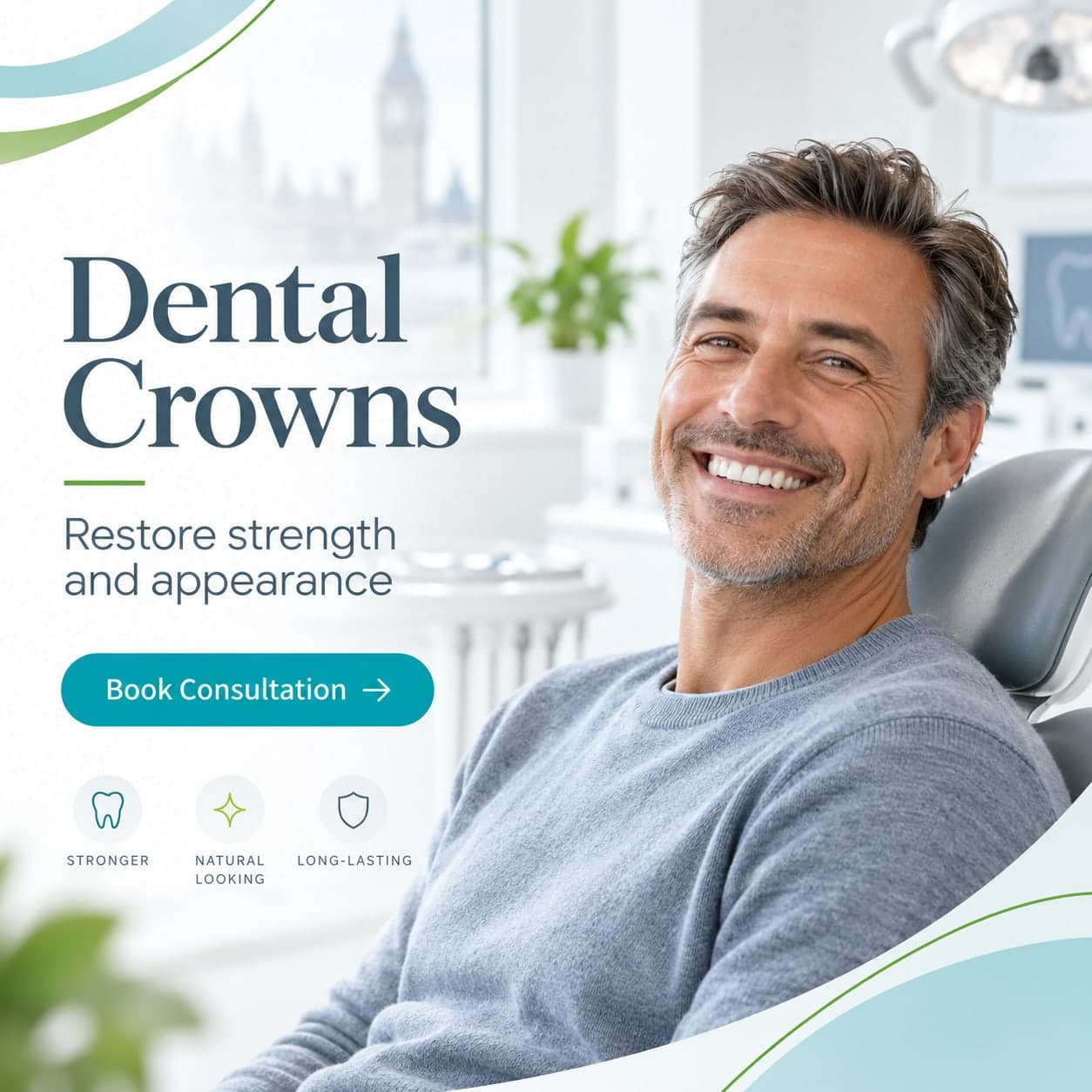
A filling replaces part of a tooth. A crown replaces the outside of the whole tooth — and holds a weakened one together.
When is a crown the right answer?
- After root canal treatment on a back tooth, to stop it fracturing.
- A large old filling that keeps failing, or where more filling than tooth is left.
- A cracked tooth, or one where a cusp has broken away.
- Heavy wear from grinding, where teeth have shortened and lost their shape.
- On top of a dental implant, as the visible replacement tooth.
- A badly discoloured or misshapen tooth where a veneer wouldn't provide enough coverage or strength.
If there's still plenty of healthy tooth, a filling or an inlay/onlay (£850) is the more conservative choice, and we'd suggest that first. Crowns involve reshaping the tooth all the way round, so they're for when there's a real reason.
Crown, veneer, inlay or filling?
These overlap, and the right one depends on how much sound tooth is left.
| Covers | Price here | Usually chosen when | |
|---|---|---|---|
| Composite filling | A small part of the tooth | from £160 | Decay or a small chip |
| Inlay / onlay | The biting surface and some cusps | £850 | A large cavity, but strong walls remain |
| Crown | The whole tooth, all round | £950 | Little sound tooth left, or after root canal treatment |
| Veneer | The front face only | £950 | Appearance of a front tooth, tooth otherwise healthy |
Step by step
What's involved in having a crown fitted
Assessment
We check how much healthy tooth is left and whether the nerve is healthy. Sometimes root canal treatment is needed first — better to find that out now than after the crown is made.
Preparing the tooth
Under local anaesthetic, the tooth is reshaped so the crown fits over it without looking bulky. Any decay or failing old filling is cleared out and the tooth built up underneath if needed.
Impressions and shade
A precise impression or scan goes to the laboratory, along with the shade we've matched to your neighbouring teeth. A temporary crown protects the tooth in the meantime.
Fitting
The finished crown is tried in and checked for fit, colour and bite before it's cemented. If anything isn't right, it goes back — a crown that's a fraction high is uncomfortable for as long as it's there.
Looking after it
Brush and clean between the teeth as normal. The crown can't decay, but the natural tooth underneath it can at the margin, so hygiene visits matter. A night guard (£280) is worth it if you grind.
Fees
How much does a dental crown cost in Kennington?
| Treatment | Price |
|---|---|
| Porcelain or metal-free crown | £950 |
| Full gold crown (60% gold) | £950 |
| Gold inlay/onlay (60% gold) | £950 |
| Porcelain inlay/onlay | £850 |
| Composite (white) filling | from £160 |
| Night guard | £280 |
Gold is still the hardest-wearing material for a back tooth and is kinder to the tooth opposite it. It's a genuine option where appearance matters less than longevity.
Questions
Frequently asked questions
How much is a dental crown in London?
A porcelain or metal-free crown at Pure Elegant Smile is £950. A full gold crown is also £950, and a porcelain inlay or onlay — a more conservative option where enough tooth remains — is £850.
How long do crowns last?
Many years when they're looked after, though no crown is permanent. What usually ends a crown's life is decay in the natural tooth at the edge of it, which is why cleaning around the margin and attending hygiene visits matters.
Does having a crown fitted hurt?
The tooth is numbed before it's prepared, so you shouldn't feel the treatment. Some sensitivity while the temporary crown is on is normal and settles once the final crown is fitted.
How many appointments does a crown take?
Two. The first prepares the tooth and takes impressions; the second fits the finished crown once the laboratory has made it. A temporary crown protects the tooth in between.
Will a crown match my other teeth?
Yes — the shade is matched to your neighbouring teeth before the crown is made. If you're planning to whiten, do it first: porcelain doesn't lighten, so the crown is matched to your final shade.
What's the difference between a crown and a cap?
Nothing — they're the same thing. "Cap" is the everyday word and "crown" is the dental one.
My crown has come off. Is that an emergency?
Ring us the same day — the exposed tooth underneath is vulnerable. Keep the crown and bring it in, as it can often be re-cemented. Don't try to stick it back with household glue. Call 0203 950 6620.
Book an assessment
Bring us the tooth you're worried about and we'll tell you whether it needs a crown, whether something more conservative would do, and exactly what it costs.
Or call us on 0203 950 6620
Mon, Tue, Thu, Fri 10am–7pm · Closed Wed, Sat, Sun97 Kennington Lane, London, SE11 4HQ
Reviewed by Dr Nader Gavgani, GDC 75484